Comparison
Riverside vs Zoom: the guest who never arrives
Zoom records the call, so the file carries the connection. Robotic vowels, dropped syllables, a frozen frame at the best sentence. Riverside records each person locally at full quality and uploads afterwards. This page covers which failure each one prevents, the cheaper fix nobody tries first, and what happens once the recording is safe. By the end you will know whether the premium is insurance you actually need.
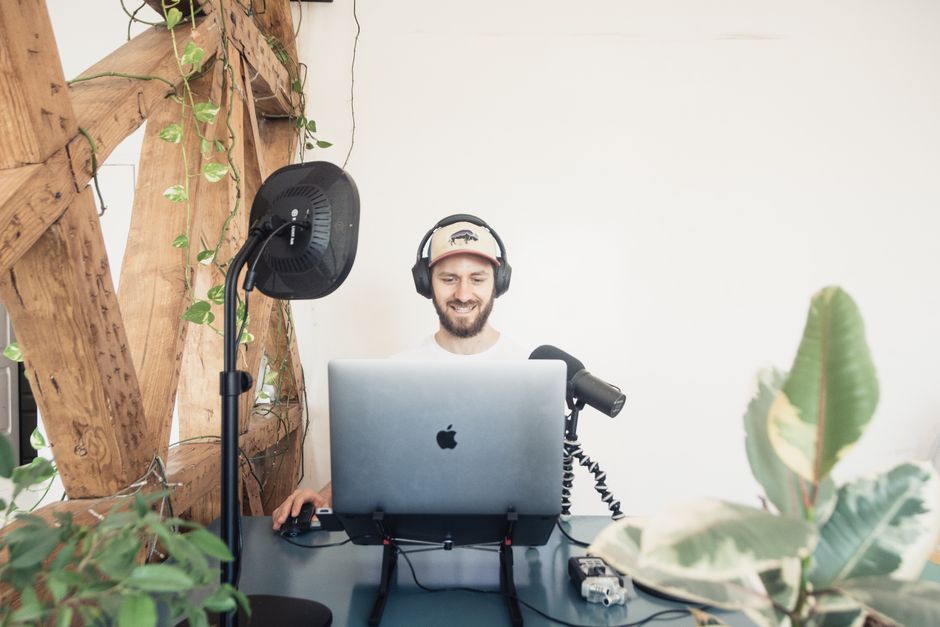
- How much of a remote interview a bad connection can take from you
- 4 minutes
- What you get once the guest has left the call
- 0 retakes
- The cheaper fix nobody tries first
- 1 wire
A call recording carries every second of a bad connection
Compression on a live call is tuned for conversation, not for publishing. It drops what a listener can infer. Fine in a meeting, audible in an episode.
The failure is unrecoverable. Four minutes of damaged audio in a forty minute interview cannot be repaired later by any editor.
The best sentence in the conversation is as likely to be inside those four minutes as anywhere else.
Local recording changes what fails. Each participant is captured on their own machine and the files upload after the call. The connection then affects the conversation rather than the asset.
What you are insuring is a guest you cannot book twice. Somebody gave you forty minutes on a Tuesday. There is no second Tuesday.
Video makes it worse than audio. A frozen frame lands on the sentence you most wanted to clip.
Two different products that both put two faces on a screen
One is built for a conversation that ends when the call ends. One is built for a file somebody publishes afterwards.
| Zoom | Riverside | |
|---|---|---|
| Built for | The meeting | The recording |
| Quality depends on | Everyone's connection | Everyone's local machine |
| Failure mode | Damage baked into the file | A slow upload afterwards |
| Right when | The recording is a record | The recording is the product |
| Also gives you | Everything a company needs for meetings | Editing and clip tools for shows |
Zoom is right when the recording is a record rather than a product
Internal meetings, customer calls, training sessions, anything watched once by people who were meant to be there. The recording is evidence, not an asset.
It is already installed, already paid for and already understood by every guest you will invite. That removes the friction of asking somebody to join an unfamiliar tool.
The friction is real. A guest fighting a browser permission dialogue for five minutes starts the conversation badly. Some of them do not turn up at all.
Send the join link a day early and ask them to open it once. Five minutes on Monday buys back the first five minutes of the interview.
So the honest framing is not that one tool is better. Publishing changes the requirements, and most calls are not published.
There is a middle route too. Record locally at both ends with whatever software each person already has. Use the meeting tool for the conversation. It is clumsy and it costs nothing.
Where a remote interview actually breaks
Only one of these steps is unrecoverable. Spend the money there and improvise everywhere else.
Booking the guest
The scarce thing, and no tool fixes it
Their connection
Unrecoverable if it lands in the file
The conversation
Preparation, not software
The edit
Recoverable later, at a cost in hours
This is the whole editor
Highlight a phrase and a clip lands on those exact words. No timeline, no keyframes, no layers.
Riverside is insurance, and the premium is worth it only if you publish
Local recording, separate tracks per speaker, and tools for pulling clips out afterwards. Those are the reasons shows buy it.
Separate tracks matter more than first-time buyers expect. Fixing one person's audio without touching the other is the difference between a fifteen minute repair and an unusable file.
The trade is a heavier ask on guests. A browser tab that must stay open. An upload that must finish. Occasionally a permission dialogue you talk somebody through.
There is a cheaper first step. A wired connection, a lapel microphone and a quiet room fix more than any subscription and cost less than two months of one.
Ask what happens when an upload fails. Where the local file sits on the guest's machine, and how you retrieve it, is the difference between a delay and a lost interview.
- Meetings, internal training, calls watched once: the meeting tool, and stop there.
- A published show with remote guests: local recording, and test it once before a real interview.
- Everyone in one room: neither, and buy two microphones instead.
- A vertical ad rather than an episode: Cutroom, and three minutes of footage becomes the finished cut.
Neither one makes the conversation worth listening to
Recording quality is a floor rather than a ceiling. Below it people leave. Above it nobody stays for the bitrate.
What decides whether an episode is heard is the guest, the question and the first ninety seconds. Those are preparation problems and no tool has fixed one.
Write three questions you would be slightly embarrassed to ask. That is a bigger lever than either subscription and it costs nothing.
Then listen back to your last episode at the ninety second mark. If you would have left, the fix is upstream of every product on this page.
Be honest about the goal too. Long-form conversation is a relationship format. Treating it as an acquisition channel is where most business podcasts quietly stop.
Read your own download numbers once a month. It is uncomfortable and it is the only honest measure of whether any of this is working.
After the recording is safe, the ad still has to be cut
Capture is one job. Turning the result into something short that sells is another. Neither tool here does the second one.
Cutroom does only the second one, and it does all of it. One talking-head take of up to three minutes goes in. A finished 9:16 MP4 comes back.
You direct it on the transcript. Highlight a phrase and coverage lands over exactly those words. Delete a line and the cut rebuilds. Change the pace and it re-cuts.
Captions ship in six packs, timed to the speech. B-roll coverage is capped by pace at 40, 45 or 52 percent, so the speaker stays visible.
A batch is 100 credits and an export is 20 credits per output minute. A thirty second ad is 110 credits.
The facts a buyer needs: it records nothing, one speaker only, three minutes at upload and 9:16 out. The trial runs 7 days on 300 credits with no card.
Riverside and Cutroom, row by row
Two rows go to Riverside and a published show needs both. The other five start where the recording stops.
| Riverside | Cutroom | |
|---|---|---|
| Records remote guests | Locally, per person | No recording at all |
| Hour-long sessions | Full episodes | Three minutes at upload |
| A finished ad from one take | Clips, not ads | Cut, captions, b-roll, music |
| The whole cut drafted on upload | You edit it afterwards | Drafted for you |
| Coverage placed on the phrase | Your footage only | Free library, capped |
| Captions timed to the speech | Clip tools, you style them | Six packs, burnt in |
| Trial without a card | Check their current terms | 7 days, 300 credits |
Questions people ask
- Is call-recording quality good enough to publish?
- Sometimes, on a strong connection, and you cannot know which calls those are until afterwards. The risk sits on the guest's end where you cannot see it. For anything you can only record once, that is the wrong bet.
- Do guests find local recording harder?
- Slightly. It usually means a browser tab that stays open and an upload that finishes, plus the occasional permission prompt. Send a one-line instruction in advance and test it once with a colleague before a real guest.
- What actually improves a remote recording most?
- A wired connection, a lapel or USB microphone and a room without hard echo. Those three cost less than two months of any subscription and fix more than software does.
- Who should buy neither?
- Anyone whose deliverable is short vertical ads. Both are built around long conversations, and paying for multi-track capture to make thirty-second cutdowns is buying a studio to send a text message. Film three minutes on a phone and let Cutroom cut it for 100 credits.
The recording is the only part you cannot redo. Everything after it is Cutroom's job: the cut, the captions and the coverage, from three minutes of footage.